All Roads Lead to Lending

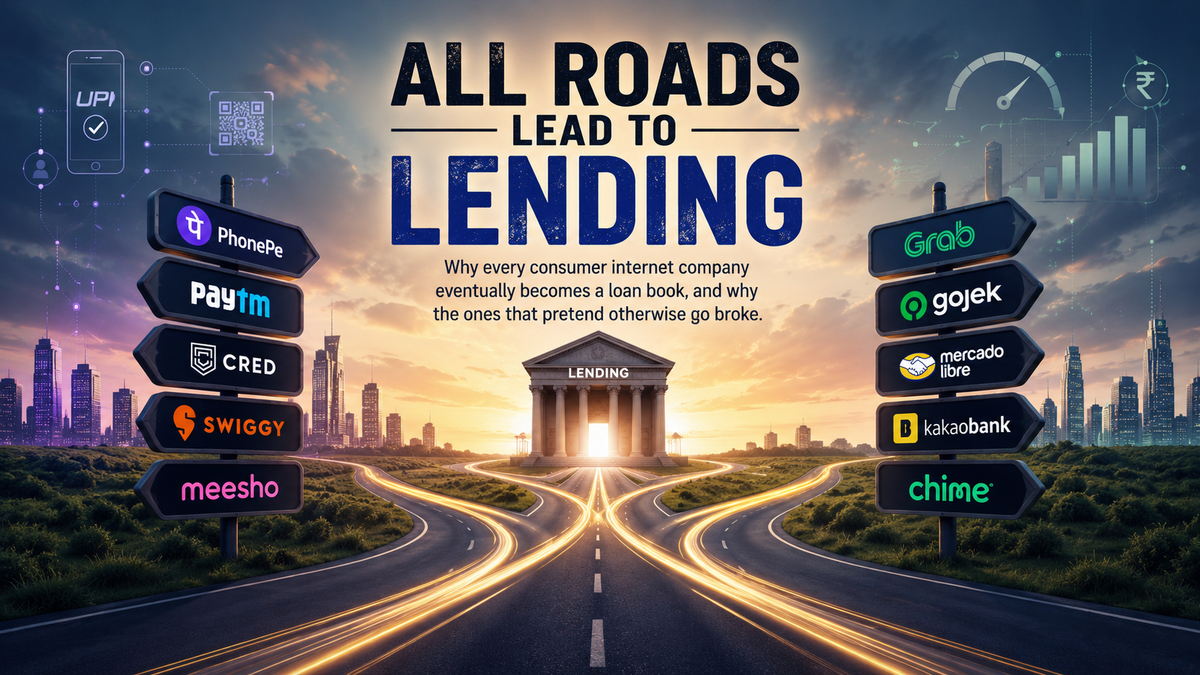
All Roads Lead to Lending
Why every consumer internet company on earth eventually becomes a loan book, and why the ones that pretend otherwise go broke.
In November 2020, the People's Bank of China cancelled the largest IPO in history. Ant Group was three days from listing at a value of $315 billion when regulators told them it was off.
The headlines blamed Jack Ma's speech. The real reason was on page 71 of the prospectus. Ant had a 1.7 trillion yuan loan book. It funded two per cent of it from its own balance sheet. The rest sat on the books of Chinese banks, who took the risk while Ant collected the fee, the data, and the equity multiple.
What looked like the world's biggest payments company was, on closer look, the world's biggest loan distributor with no skin in the game.
Five years later, the same story is playing out in India, Southeast Asia, Latin America, and the United States. Every consumer internet company of any size has either pivoted to lending, tried to pivot to lending, or is being asked by its board why it has not pivoted yet. The Indian cases are just the most visible chapter of a global pattern. And once you see the pattern, you cannot unsee it.
The thing nobody wants to say about payments
Look at what payments companies actually earn per transaction.
In India, UPI is regulated to zero MDR on most consumer-to-merchant flows. Card interchange is capped. Wallet top-ups make almost nothing. Even offline merchant payments earn a few basis points. PhonePe processes 9.15 billion transactions a month, controls 45 per cent of UPI, earns Rs 7,115 crore in revenue, and still loses Rs 1,727 crore a year. The biggest payments business in the world's biggest payments market still loses money.
This is not a PhonePe problem. It is structural. The state decided early that digital payments would be free at the point of use, in service of financial inclusion. That worked. The cost is that nobody actually makes margin on the transaction itself.
So the question every payments company has had to answer, quietly, for years, is: if payments do not make money, what is the payments business actually for?
The answer is always the same. Payments are not a business. Payments are the most expensive customer acquisition channel ever built, dressed up as a product. The actual business is whatever sits on top of the payment graph and earns money from the user once they are inside. In any country with real credit demand, that thing is lending.
This is why PhonePe's lending and insurance revenue tripled in one year, from Rs 181 crore to Rs 558 crore. It is why CRED's lending AUM reached Rs 22,000 crore by FY25, even though the company started as a credit card bill payment app. It is why Paytm, after the RBI shut down its payments bank, rebuilt its entire P&L around lending and was profitable again in twelve months.
You can build the most beautiful payments product in the world. The unit economics will still not work. The only question is what loan you put on top of it.
Why lending and nothing else
Lending wins because everything else loses.
Insurance has a one-year sales cycle and a multi-year claims cycle. A user who buys a term plan in March does not come back until next March. You cannot build a quarterly revenue engine on a product that engages a customer once a year.
Mutual fund distribution has good margins on paper, but SEBI capped commissions deliberately. Zerodha, the biggest broker in the country, earns a few hundred crores from 1.5 crore active users. At full scale, the math does not justify a fifteen-billion-dollar valuation.
Wealth management needs human attention. The customers worth attending to demand it. The customers who do not demand it pay nothing.
Brokerage is winner-take-most, and Zerodha already won.
That leaves lending. And lending has three things consumer platforms need.
First, the revenue per loan is huge compared to payments. A Rs 50,000 personal loan, at a 2-3 per cent take rate plus a trail, earns more from one user in one event than a year of UPI activity from the same person. The math is not close.
Second, the customer is already inside. Every UPI transaction, every CRED bill, every Meesho order, every Swiggy delivery is a data point. In a country where credit bureau coverage is thin and self-reported income is mostly fiction, transaction history is the best underwriting signal anyone has. Platforms lend to users they understand better than any bank ever could.
Third, the demand is huge. India's consumer loan market grew from $80 billion in March 2020 to $212 billion in March 2025. The credit gap, especially for the half a billion Indians outside the formal system, is the largest growth opportunity in the consumer economy. For 800 million people, a Rs 8,000 loan is the difference between paying a hospital bill and not.
The platforms that crack this are not building fintechs. They are building the next generation of consumer banks, with one difference. They need no branches, no deposits, and no one walking through a door.
The Ant Group lesson nobody learned
Ant did not get destroyed by Jack Ma's speech. Ant got destroyed by a number.
Two per cent. That is what Ant funded of its own loan book. The other 98 per cent was originated by Ant, underwritten with Ant's data, distributed through Alipay, serviced by Ant, and dropped onto the books of Chinese banks, who took the credit risk and paid Ant a fee.
This is the model every platform on earth has wanted to copy. It is also the model most regulators have eventually moved to dismantle.
The RBI reached the same conclusion in 2022, then again in 2023. The Digital Lending Guidelines banned the structures fintechs were using to take all the upside while leaving the downside with banks. The First Loss Default Guarantee was capped at five per cent of the portfolio, the most skin a fintech could put in. In May 2025, the RBI tightened it again with the Digital Lending Directions.
What these rules do, beneath the legal language, is end the arbitrage. Before the rules, a platform could distribute a loan, take a fee, and bear no risk. After the rules, the platform has to either take real credit exposure, become a regulated lender, or accept smaller margins. The lending business, for everyone now, is closer to actual banking than it has ever been.
Paytm felt this first, and Paytm is also where the lesson is most useful, because it forces you to separate two very different products that get lazily grouped together as "Paytm lending."
The consumer side, Paytm Postpaid, took the hit. Small-ticket unsecured BNPL to first-time formal borrowers. The November 2023 risk-weight hike, followed by the January 2024 restrictions on Paytm Payments Bank, forced Paytm to pause this product. Disbursals fell by half in one quarter. That part of the lending book had to be unwound.
The merchant side did the opposite. It quietly became one of the best lending businesses in India.
Paytm's merchant loan distribution sits on top of a 4.4 crore merchant base, with 1.3 crore subscription merchants running soundboxes and QR codes whose daily settlement data flows through Paytm's own rails. That is the dream underwriting setup. You can see, in real time, what every merchant earns, when they earn it, and whether their volume is growing or shrinking. The borrowers are running observable businesses, not first-time consumers, which means the adverse selection problem that hit Paytm Postpaid does not apply here. In FY26, repeat borrowers crossed 50 per cent of merchant loan disbursements, which is the cleanest possible signal that the underwriting is working.
The numbers are now hard to argue with. Distribution of financial services revenue grew 52 per cent in FY26 to Rs 2,594 crore, adding Rs 890 crore of revenue over the previous year. The merchant loan engine was the biggest contributor. Paytm posted its first full-year profit of Rs 552 crore in FY26, on the back of this segment. The model is asset-light, distribution-only, no credit risk on Paytm's balance sheet. The loans sit with partner banks and NBFCs. Paytm earns the fee.
The lesson from Paytm is not "lending broke them." The lesson is the opposite. The right kind of lending, on the right kind of user base, with the right kind of regulatory model, is what saved the company. Consumer BNPL to credit-fragile users blew up. Merchant lending to businesses Paytm could actually see, did not. Same company, same payments platform, same year, two completely different outcomes. The difference was the borrower.
The platforms that read this correctly understood the era of consequence-free lending was ending. PhonePe positioned itself as a distributor, not a lender, taking smaller fees but no credit risk. Flipkart spun out Super.money, applied for an NBFC licence, and is waiting for RBI approval. Amazon bought Axio, an existing NBFC, rather than build one inside Amazon Pay. These are not coincidences. They are the same adaptation, by three different companies, to the same rules.
The platforms that did not read this correctly are now defined by the gap between what they wanted to be and what the regulator let them become.
The adverse selection trap
Here is the part no Indian fintech founder will say in public.
The first users who take a loan from your platform are, on average, the users who need a loan the most. The users who need a loan the most are, on average, the least likely to pay it back. This is not a small effect. It is the central problem of consumer lending, and it is why most platform lending experiments produce a curve that looks like growth, then a curve that looks like a cliff.
Goldman Sachs walked into the Apple Card in 2019 with the cleanest possible setup. Apple's users are affluent, digital, and creditworthy. The product had no fees and a clean interest structure, built to attract responsible customers. Goldman had the capital and the team to absorb early losses.
It did not work. Loss rates ran above industry averages within two years. The users most drawn to a no-fee, transparent credit card turned out to be the users for whom the lack of fees actually mattered, which correlated with the users most likely to miss payments. Goldman's consumer lending unit lost over seven billion dollars between 2020 and the sale of the Apple Card portfolio to JPMorgan Chase in January 2026, at a discount of more than a billion dollars.
The richest tech company in the world, paired with one of the most sophisticated banks in the world, trying to do consumer lending in the biggest credit market in the world, lost seven billion dollars. The lesson is not that consumer lending is hard. The lesson is that the populations most attractive at the top of your funnel are, almost always, the populations least suited to receive credit.
This is the trap that hit BharatPe early. The merchant base was real but small, informal, and undercapitalised. The first wave of merchants who took loans turned out to be the ones least equipped to absorb cash flow shocks. NPAs ran higher than the established NBFCs. The CEO at the time said in public that anyone who knew anything about lending would have told them what they were doing was wrong. That was honest, and slightly late.
It is also the trap underneath Paytm Postpaid. The product worked for two years. Disbursals grew to Rs 6,000 crore a month. The users were small-ticket, often first-time formal borrowers using BNPL to smooth weekly cash flow. The asset quality looked fine. Then the credit cycle tightened, the RBI raised risk weights, and the same population that had looked like growth became a solvency risk overnight. Paytm did not collapse, but the loan book had to be unwound in a way that took years to rebuild.
The companies that have built lending businesses that work, in India and elsewhere, have done one thing differently. They selected for low-credit-risk users from day one, often without admitting that was what they were doing.
CRED is the cleanest case. Kunal Shah's hypothesis, "take care of the people who already pay their credit card bills on time," was in retrospect the most elegant credit filter ever built into a consumer product. The cashback was the lure. The behavioural data was the gold. By the time CRED started lending at scale, it was lending to a population whose credit behaviour had been observed in real time for years.
PhonePe's user base, biased toward salaried, urban, digital users, has a similar quality. The lending product is grafted onto a population that already has formal credit and uses the platform for routine activity. The asset-light model means PhonePe never has to find out what its loss rate would look like on its own balance sheet, because the loss rate stays with the bank.
Mercado Libre, the biggest e-commerce and fintech platform in Latin America, is doing the same at continental scale. Its credit portfolio reached fourteen and a half billion dollars by Q1 2026, growing 87 per cent year on year. It underwrites against marketplace transaction data. The users have observable spend, income, and behaviour. The net interest margin after losses, the only honest metric in lending, sits at 17-18 per cent, lower than two years ago but still high enough to make fintech 41 per cent of revenue and most of the incremental margin.
What CRED, PhonePe, and Mercado Libre share is not that they "built the product first." Plenty of companies do that and still fail at lending. What they share is that the underlying product, by accident or design, filtered the user base into a population the company could lend to without losing its shirt.
Why Ola, BharatPe, and Paytm Postpaid failed at the same thing
It is now possible to say what really went wrong in these specific Indian failures, because the global parallels make the pattern obvious. To be clear, this section is not about Paytm the company, which has built one of the most successful merchant lending businesses in the country. It is about Paytm Postpaid, which was a different product, sold to a different user base, with a different outcome.
Ola tried to build lending on top of ride-hailing. The platform had data. It had a captive user base. The mechanics looked right. But the underlying business, on both sides, had structural problems. Drivers were a high-churn, low-margin population with volatile daily cash flows. Riders were a recurring user base, but the engagement was thin, transactional, and easily lost to competing apps. The acquisition of Avail Finance in March 2022, for fifty million dollars, was a tell. When the answer to "how do we build a lending business" is "let us buy one from the founder's brother," you are not solving the funnel problem. You are papering over it. Avail stopped lending by December 2022 and was wound down.
BharatPe had a different version of the same problem. The merchant base was real but the merchants themselves were small, informal, first-time borrowers. The first wave of NPAs revealed what the company should have known: a payments-led merchant network is not the same thing as a creditworthy merchant network. BharatPe has since restructured, and lending volumes are recovering. But the original thesis, that a merchant network alone produces a creditworthy borrower base, did not hold.
Paytm Postpaid is the most painful case among the consumer products, because the business was working. Rs 6,000 crore in monthly disbursals. Profitable unit economics. A credit product that genuinely served users with no other formal access. The problem was that the population was, in aggregate, more credit-fragile than the models implied, and the RBI knew this before Paytm's investors did. When risk weights went up in late 2023, the assumption Paytm's consumer book was built on, that small-ticket unsecured BNPL was low-risk at scale, was withdrawn by policy. The book did not collapse because of fraud. It collapsed because the consumer borrower population was always more correlated to credit cycles than the company had modelled. The merchant book, sitting next door, did not collapse because the merchants were a different population entirely.
In each of these consumer cases, the failure was not "the product was not ready." The failure was that the platform confused engagement with creditworthiness. They are not the same thing. They are almost opposite. A user who opens your app twelve times a day is not, because of that, a user who will repay a Rs 25,000 loan when their auto breaks down. A merchant whose daily settlement runs through your soundbox is a different proposition entirely. That is why Paytm's merchant book works and its consumer book did not.
The B2B mirror
The same dynamics, with one important inversion, play out in B2B.
Infra.market, the construction materials marketplace, has spent three years quietly becoming a lender. Cement margins are thin. Working capital cycles for contractors are punishing. The actual high-margin product in the construction supply chain is not the materials. It is financing the period between when the contractor orders the cement and when the project pays out. The Rs 185 crore debt round in mid-2024 was raised so Infra.market could lend it. The marketplace is becoming the data layer for the financing business that is the actual P&L.
Meesho has moved similarly. Meesho Finance offers credit lines from 18 per cent per annum to its sellers. The marketplace sees every transaction, knows the cash flow rhythm, and can underwrite against data no external lender can access.
The inversion in B2B is that adverse selection works the other way. The sellers and merchants who take credit are not, by default, the riskiest. They are often the ones with the strongest cash flow, using credit to scale rather than survive. The unit economics of B2B lending, when properly underwritten, tend to be better than consumer lending, precisely because the borrower is observably running a business, not a household.
This is why B2B versions of the lending pivot have largely worked, even at companies whose core marketplace economics are fragile. Infra.market may or may not survive as a cement marketplace. It will probably survive as a contractor finance business, because the underlying product, working capital credit, has structurally better unit economics than anything else the company sells.
The international story
Klarna, Affirm, and the global BNPL wave are not separate phenomena. They are the same pattern, in a market where retail infrastructure is more mature.
Affirm and Klarna are the answer to what happens when the platform layer is owned by someone else, like Shopify or Amazon, and lending is the only thing a new entrant can build. Affirm posted forty-two per cent GMV growth in its last quarter, to $10.8 billion, with revenue less transaction costs rising sixty per cent. Klarna, with its zero-interest model and merchant-funded economics, takes a different route to the same destination. The fact that both companies arrived at lending as the core engine, from very different starts, is the giveaway. Once you have a captive consumer relationship at scale, the only product that monetises it well enough to justify your equity is credit.
Southeast Asia tells the cleanest version. Grab spent five years building ride-hailing and food delivery into a single super-app, and finally turned profitable in 2025. The profitability was not driven by the platforms. It was driven by GrabFin, whose loan book hit $1.2 billion by year-end 2025. Sea Group's digital financial services revenue is nearly $500 million a quarter, on a credit portfolio above $3 billion. GoTo's fintech unit turned EBITDA positive in 2025, driven by lending volumes that grew 168 per cent year on year.
The pattern across all three Southeast Asian super-apps is identical to India's. The original product was the customer acquisition layer. The actual business was always going to be lending, and the profitability arrived the year lending crossed scale.
None of these are coincidences. They are all responses to the same force. In any consumer market where the platform layer captures attention but cannot earn meaningful margin on the transaction, the only way to make the business work is to attach a lending product.
What this means
If you take this seriously, the conclusions are uncomfortable.
The next five years of consumer internet, globally, will be defined by which platforms built a lending business on a user base creditworthy enough to absorb the loans, and which tried to lend to users who turned out not to be.
Every founder pitching a consumer marketplace, a vertical SaaS for SMBs, a creator platform, a quick commerce app, or any consumer-facing business will eventually be asked, by their board, when they intend to add lending. The honest answer in most cases will be "we cannot, because our users will not repay." That answer will not be acceptable. The pivot will happen anyway. The losses will follow.
The regulatory environment, in every major market, will keep tightening. China moved first in 2020. India followed in 2022, 2023, and 2025. The US, through the CFPB and OCC, has been restricting non-bank lending. The EU has been hostile to embedded lending from the start. The path is the same in every country. The regulator eventually catches up to the fact that lending without a bank's capital requirements is not a clever business model. It is regulatory arbitrage. And regulatory arbitrage has a shelf life.
The winners in this next phase will not be the platforms with the biggest user bases. They will be the platforms whose user bases were, by accident or design, structurally creditworthy. CRED selected for this from the beginning. PhonePe inherited it from UPI demographics. Mercado Libre built it from e-commerce data. The platforms whose users came for cheap food delivery, free ride-hailing, or zero-MDR payments are now finding out that the same things that drove user acquisition also produced a user base that is, in aggregate, expensive to lend to.
The dominant business model of consumer internet, the one that has produced the largest valuations of the last decade, is not actually consumer internet. It is consumer credit, distributed through consumer internet. The Alipays and PhonePes and Grabs of the world are the largest non-bank lenders in their economies. They are valued as tech companies, but they earn as financial institutions. The gap between how they are seen and what they actually are is where most of their equity value sits.
In a world where attention is free, transactions are subsidised, and software is being commoditised by foundation models, the only product whose unit economics still produce real margin is credit. The consumer internet platforms of the next decade will be valued on the quality of their loan books. The ones that built creditworthy user bases will compound. The ones that did not will spend years explaining to investors why their NPAs are temporarily elevated, until they are quietly acquired by someone who knows how to do this properly.
The Ant Group cancellation in 2020 was not a Chinese story. It was a preview. Five years later, in markets from Mumbai to Jakarta to São Paulo, the same lesson is being learned by the same kinds of companies, in roughly the same order. The platforms that have figured out lending are now worth more than the platforms that built the original networks. The platforms that have not figured out lending are increasingly understood, by their own investors, to be cost centres waiting to be acquired.
Every road in consumer internet leads to lending. The question is not whether you arrive. The question is whether the people you brought with you can pay you back when you get there.
The customer acquisition was always the easy part. The collection is where the company is actually built.
All roads lead to lending because lending is the only road that pays.