Istanbul - oh - Istanbul, The City That Makes You Feel Small in the Best Way

We went to escape our jobs. We came back understanding, quietly and permanently, that comfort is the enemy of the best version of your life.
There is a particular kind of restlessness that a demanding job leaves behind. Not ambition, not burnout exactly, but a low hum of sameness. Every year we had gone to Southeast Asia for New Year and every year it had delivered precisely what it promised: loud, young, fun, and over. Turkey was not a dream destination. It was a corrective.
Every year, the same conversation. Bangkok or Bali. Bali or Bangkok. Young people, loud music, the collective performance of having the best New Year of your life. We had done it. It was fun. And then, at some point, fun starts to feel like a habit you have not examined in a while.
Turkey was not a dream destination. It was a decision. My wife and I looked at each other sometime in October and said, more or less simultaneously, let us go somewhere that will make us feel something we do not already know how to feel. The logic was not complicated. Southeast Asia at New Year is a specific product: reliable, well-reviewed, infinitely repeatable. We wanted something that had not been optimized for our comfort. We got considerably more than we asked for.
The First Lesson, Delivered at the Arrivals Gate
Istanbul greets you, in December, with cold that is not aggressive but is entirely sincere. I stepped outside the terminal and noticed, immediately, that the smoking area had wooden boards mounted along the railing at roughly shoulder height. Not signage, not shelter. Just boards, positioned at the precise angle at which a person leans when they light a cigarette in winter wind. The airport had, apparently, engineered infrastructure around its smokers' comfort. I had read that Turkey smokes. I had not understood, until that moment, that Turkey smokes with institutional commitment.
It was a small thing. But travel begins in small observations, and this one arrived in the first four minutes.
The Luggage Situation, or: Two Indian Couples Walk Into an Airport Lost-and-Found
We had been in our hotel room for perhaps forty minutes when my wife opened the bag she had collected from the carousel and we both understood, in the same instant, that this was not our bag. Same make, same color, different life inside it. The connecting flight to London presented itself, immediately, as the most plausible and most catastrophic explanation. Our luggage was in London. We were idiots. The trip was finished before it had properly started.
Except we were not quite that stupid, and neither, it turned out, was anyone else. We took the fifty-euro ride back to the airport, a fact I note not for the cost but for the specific quality of silence between two people who are trying very hard not to say what they are actually thinking. The good news about Istanbul's airport is that they simply let you back in. No documentation, no small ceremony. A man looked at us, understood the situation, and waved us through.
I was trying to find the lost-and-found in a language I did not speak, in a country where pointing and hoping gets you further than you expect but not quite far enough.
And then, across the terminal, someone shouted my name. In Hindi. The relief of hearing your own language in a place where nothing around you is familiar is not a small thing. It is, in that moment, everything. The other couple had made the identical mistake, realized it in their hotel room, and arrived at the same lost-and-found at almost exactly the same time. We stood there, two Indian couples in Istanbul, holding each other's bags, laughing in the way people laugh when the alternative is too embarrassing to consider. We shared the cab back. The trip, now truly beginning, felt like it had already given us a story.
The City Itself, Which Resists Summary
Istanbul does not build to a climax. It simply opens, continuously, as if it has been saving things for you specifically. The Galata Tower sits in a neighborhood that operates like a small, self-sufficient world: the kebab vendors and the shopkeepers and the tourists circling each other in a negotiation that has been ongoing for centuries and shows no sign of resolution.
The Hagia Sophia is where the trip starts to do something to your sense of scale. You stand inside a building that has been, in its long life, a cathedral and a mosque and a museum and a mosque again, and you realize that the architecture has absorbed all of it. The Christian mosaics and the Islamic calligraphy share the same walls with a composure that the humans who commissioned them never quite managed. The building is less interested in the argument than its occupants were. That is worth sitting with.
Somewhere in the middle of all this, our bus guide told us that the Ottoman sultan who built Dolmabahce Palace had borrowed heavily to do it. He wanted grandeur and did not have the budget for grandeur and borrowed until he did. The palace is extraordinary. The debt contributed, not insignificantly, to the empire's decline. I laughed. My wife looked at me. We both knew people like this. We might, at various points, have been people like this. History is funny when it is sufficiently old.
The Bosphorus at Sunset, Which Is the Whole Point
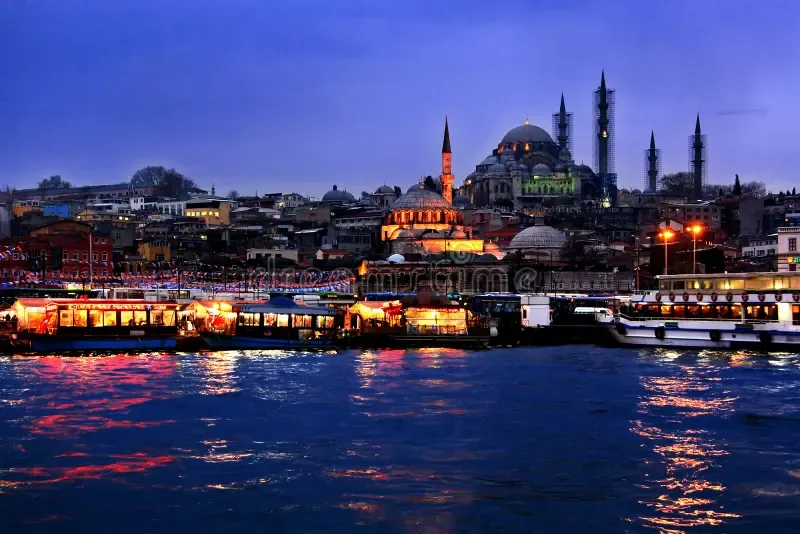
The evening cruise on the Bosphorus is listed in every guidebook and should be done regardless. What the guidebooks cannot fully prepare you for is the specific quality of Istanbul from the water at dusk. My wife and I moved to the nose of the boat and sat there, quietly, for the better part of an hour. The city arranged itself on both banks: minarets and bridges and old stone and, occasionally, a high-rise that the skyline has not yet decided how to feel about. The light was doing something particular with the water. The wind was cold in the committed way December wind in Istanbul is cold. Neither of us said very much.
Istanbul makes you feel small in the best possible way. Not diminished. Correctly proportioned. Like someone has finally handed you a map at the right scale.
One amazing thing after another, until the mind goes pleasantly blank and stops trying to file and categorize and simply receives. That is a rare condition to arrive at. Most cities do not produce it. Istanbul produced it on day two.
Cappadocia, Where the Landscape Misbehaves
The problem with Cappadocia is that it has been photographed so comprehensively that arriving there feels, briefly, like visiting a place you have already been. The fairy chimneys, the cave hotels, the dawn balloons drifting above the valley in a formation that no reasonable landscape has any business producing. And then you are actually there, in the actual light, and the photographs turn out to have been accurate in every dimension except the one that matters, which is presence.
We were lucky with the weather. The balloon went up at dawn. We rose over a landscape that looked, genuinely, like a planet a child would draw if you asked them to invent one, and the guides were precise and professional in a way that made me think, not for the first time on this trip, about what Indian tourism could be if we decided to take hospitality seriously as a standard rather than as an amenity reserved for five-star properties.
Antalya, and the Mediterranean, Finally
Seeing the Mediterranean Sea for the first time is not a neutral experience. It is a body of water that carries the weight of every civilization that ever decided to build something near it, and the ruins scattered around Antalya make that weight visible in the most literal sense. We walked through old stone in afternoon sun and felt the particular pleasure of a place that does not explain itself to you but simply exists, in its layered, complicated, sun-warmed way, and trusts you to meet it where it is.
It did not surpass the Bosphorus. Nothing on this trip surpassed the Bosphorus. But the Mediterranean delivered on its reputation and the old quarter on New Year's Eve had a warmth that the evening deserved.
Coming Home
We came back the same people. The jobs were still there. The routines were still there. Nothing had been resolved or transformed in the way travel writing sometimes promises. But something had shifted, quietly and without fanfare, in the way a lens shifts when someone adjusts the focus correctly.
We had been uncomfortable. We had been lost, literally, in an airport in a country whose language we did not speak. We had been cold and disoriented and briefly convinced our luggage was in London. And every single moment of that discomfort had delivered something that the familiar, comfortable, reliably enjoyable Southeast Asia itinerary had stopped being able to deliver.
We go back to the same things because the same things feel safe. That feeling of safety is real and worth something. But it costs something too, and Turkey reminded us what that cost is. The best version of a trip, and possibly of a life, is usually on the other side of the thing you almost did not say yes to.
Go to Turkey. Stand at the nose of a Bosphorus ferry with someone you love and let the city make you feel correctly proportioned. You will come back changed in no dramatic way and in every way that matters.